


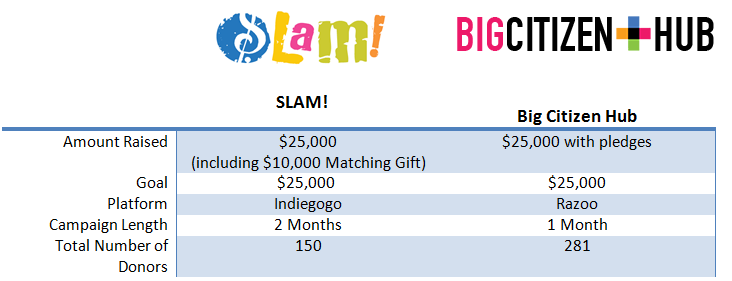
While the #Icebucketchallenge and other viral memes come and go, crowdfunding is here to stay. Two projects of Community Partners -- SLAM! and Big Citizen Hub -- raised at least $25,000 each in crowdfunding this year. Roi Matalon, the project leader of SLAM!, and Mario Fedelin, project leader of Big Citizen Hub, generously shared their takeaways and advice on running a successful crowdfunding campaign. Click here to visit SLAM!'s Indiegogo page and here for Big Citizen Hub's Razoo page.
1. Planning and Preparation Matter
Planning a successful crowdfunding campaign is not as easy or simple as it looks. Stories of absurdly lucrative, yet simple campaigns (see: Potato Salad Kickstarter) are the exception, not the rule. Give yourself enough time to prepare content, recruit and train volunteer fundraisers, create a timeline and communications plan, and determine your goal and the number of donors you estimate you’ll need before you start your campaign.
Roi Matalon (RM): The more you invest in the preparation, the more successful your campaign will be. It’s not just making the video or the campaign. The one-on-one meeting with Priscilla, (Community Partners program director) was really helpful – it was important to think very carefully about the people we were going to ask, and the number of donors that were needed at all levels of giving in order to reach our goal. I did the same exact training with my campaign captains. Ultimately, it was the preparation, getting the right people as the fundraisers, and prepping them accordingly that helped make us successful.
Mario Fedelin (MF): I started too late. If I had to do it again, I would spend 2-3 months planning. There’s a lot of heavy lifting that goes into a crowdfunding campaign and it’s not as easy as just putting it out there. I would have paid more attention to creating more buzz around the campaign.
2. Crowdfunding is a Team Effort
Both Roi and Mario said they could not have reached their goals by themselves. They each mobilized a team of advocates and volunteers that were critical in spreading the word and engaging their networks.
RM: We used our network of college volunteers for fundraising – about 20 or 30 were actively involved and about 20-30 peripherally involved. The way we structured our volunteer network was to assign campaign captains. We had 5 and each was responsible for mobilizing 10 other volunteers who were already involved in the program to participate in fundraising. A large majority of donations came from 10-15 fundraisers.
MF: We had about 50 people who said they were going to help, with approximately 25 who ended up being active. First group was composed of people really close to me or Beth, our director of strategy and development, and the other group was the stakeholders who cared deeply about the mission. The stakeholders were either past participants or individuals who worked on similar programs and knew our work.
3. Work Closely with Your Volunteer Fundraisers
Roi and Mario stressed the importance of actively engaging and encouraging their volunteers and fundraisers before and throughout the campaign. A little bit of hand holding and training can help volunteers overcome their fundraising jitters.
MF: Some of our advocates were hesitant and reluctant. We tried to be very encouraging and told them to only ask people you’re comfortable with. We wrote the language for them, so they didn’t get bogged down with asking. Next time, I would help fundraisers set a goal, have better coordination of the group, and check in more frequently.
4. Use Different Channels to Communicate, but Email is King
While social media was used extensively by both projects, both Roi and Mario agree that email was the magic ingredient. Both found it key to raising funds, keeping donors engaged and feeling part of the campaign team, and even as a way to inspire fundraisers themselves.
RM: We organized two email-a-thons where teams competed to send out the most number of emails. Every person sent about 30-40 emails over the course of the event. We had sent out 400 emails in 2 hours. We felt this was going to be a better approach than a phone-a-thon, which college students aren’t comfortable doing – asking people for money on the phone. Email was a more comfortable way of asking for them.
MF: Timing counts. Send an email before the campaign, the day of the campaign, a second email when you hit 30 percent of your goal, another email when you hit 75 percent, a fifth email on the last day and the sixth email as a wrap up.
In regards to content: In the first email, include something personal. Even if people gave, continue sending emails; you’re updating them on your progress and people want to be on a winning team. If you hit 30 percent of your goal, people want to know. All the emails together made a difference, but the first email with a personal note was particularly significant.
5. Yes, You Should Have Video
But it’s only a piece of the puzzle. Be sure to have a quality, short 60 to 90 second video that can serve as an introduction to your program. Having a short video can quickly and clearly communicate your message to people who are unfamiliar with your program. In addition, videos, along with photos, are great for social media.
RM: A strong video is ultimately what gets people excited. If a video doesn’t connect emotionally, then it was unlikely that a donor was going to give. When one of us posted the video on social media, there were others that shared it as well. The video was the introduction to SLAM! for many supporters.
MF: The video is going to be a lot better for those who don’t know you. In our case, we reached out to our network and they gave because they cared about us. But the video gave us credibility with those who may have been on the fence.